DỊCH VỤ PROXY CỦA CHÚNG TÔI

Proxy cư dân-GB
Với hơn 100 triệu IP dân cư thực, yêu cầu đồng thời không giới hạn.

Proxy cư dân-IP
Mạng proxy dân cư ổn định lớn, phủ sóng hơn 200 địa điểm.

Proxy luân phiên không giới hạn
Proxy dân cư luân phiên không giới hạn, loại bỏ chi phí băng thông, phù hợp cho các tình huống sử dụng nhiều.

Proxy SOCKS5
Mạng proxy nhanh và đáng tin cậy với phạm vi địa điểm rộng và khả dụng cao, SOCKS5 được làm mới hàng ngày.

Proxy dân cư tĩnh
Mạng proxy ISP nhanh và ổn định với độ ổn định và thời gian phản hồi nhanh.

Переместить прокси
Реальные мобильные сети 3G / 4G / 5G, чистый оператор IP.
Giá gói
IP dân cư thực tại 200+ quốc gia/khu vực, luân phiên hiệu quả.
Hỗ trợ băng thông tùy chỉnh, không giới hạn lưu lượng và kết nối đồng thời.
IP hiệu suất cao với thời gian hoạt động 99,9%, nhanh và ổn định.
Реальный ресурс 3G / 4G / 5G, используемый по потоку, с расширением.
IP dân cư thực toàn cầu với nhắm mục tiêu chính xác. Không tính phí cho IP không hợp lệ.
Thanh toán theo số lượng cổng, với khoảng thời gian luân phiên từ 3 đến 30 phút.

Giới hạn IP cố định hàng ngày, có thể sử dụng lại trong vòng 24 giờ.












Chain Proxy vs Ordinary Proxy: Differences and Advantages
27/05/2026
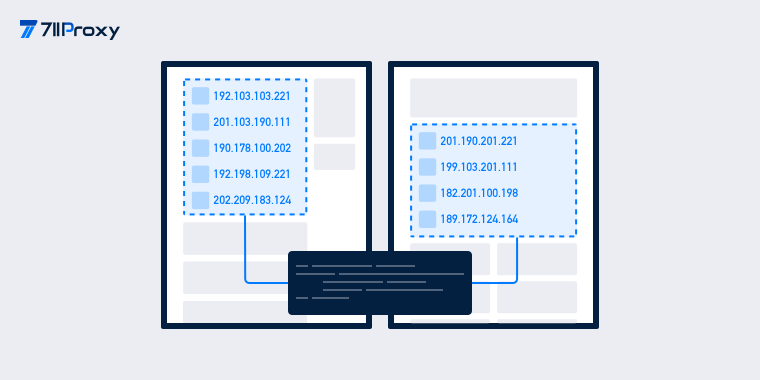
Network proxy services are now widely used in various network operation scenarios. Different types of proxies have significant differences in architecture and user experience. In this article, 711Proxy will compare the characteristics of chain proxies and ordinary proxies based on real-world use cases, helping you choose the right service according to your needs.
Basic Definitions
Ordinary Proxy
Refers to a solution where network requests are forwarded through a single proxy node. The user's request is first sent to the proxy server, which then forwards it to the target website. The entire transmission process goes through only one relay layer. The architecture is simple, with low deployment and usage barriers, making it suitable for basic network access needs.
Chain Proxy
Adopts a multi-node serial transmission architecture. The user's request passes through multiple proxy servers in sequence, being forwarded at each layer before finally reaching the target server. This architectural design creates a richer data transmission path, with higher overall complexity than an ordinary proxy. This is the most core difference between the two.
Comparison of Core Advantages
Advantages of Ordinary Proxy:
1. Fast response speed
With only a single relay layer, network latency is low, making it suitable for business scenarios with high real-time requirements.
2. Simple configuration
Users only need to fill in the proxy server address and port to complete setup, without complex link debugging.
3. Lower cost
The single-node architecture requires less technical investment from service providers, making the service price more economical.
Advantages of Chain Proxy:
1. High stability
The multi-node serial architecture provides redundancy in the data transmission link. When a single node fluctuates, link adjustments can maintain communication, reducing the impact of single points of failure on business operations.
2. Strong resistance to risks
Chain proxies effectively reduce the risk of a single proxy node being repeatedly identified and flagged, helping maintain business access continuity.
3. Wider applicability
Especially suitable for operation scenarios with high stability requirements, such as cross-border e-commerce management, public data scraping, market research, and other complex business needs.
711Proxy: A More Worry-Free Choice
As a professional proxy service provider, 711Proxy is particularly suitable for building high-quality chain proxy networks. It offers over 100 million real residential IP resources, covering more than 200 countries and regions worldwide. Each IP is strictly screened and maintained, with an availability rate of up to 99.9%, effectively reducing interruptions and retries caused by poor IP quality.
In terms of protocol compatibility, 711Proxy fully supports HTTP and SOCKS5 protocols, flexibly adapting to various proxy architectures. Additionally, 711Proxy supports unlimited concurrent requests, easily handling high-intensity business scenarios such as large-scale data collection and website testing.
Conclusion
Ordinary proxies and chain proxies each have their own applicable scenarios. In practice, they can be flexibly combined based on business needs. However, regardless of which architecture you choose, the quality of the exit node's IP is a key factor determining the final outcome.
With its premium residential IP resources, stable service performance, and professional technical support, 711Proxy provides reliable network backing for your proxy solutions.
