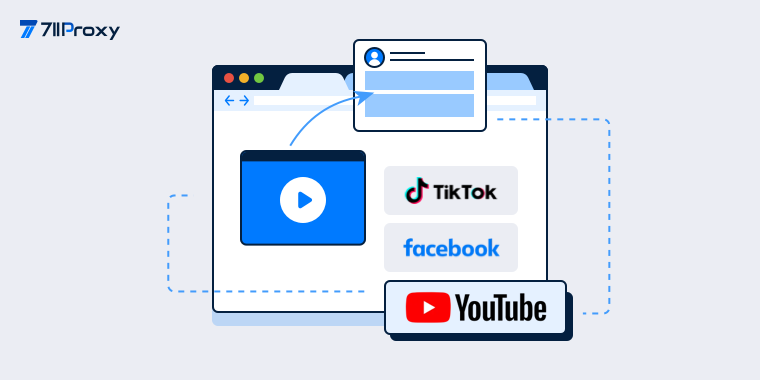
<p style="line-height: 2em;"><span style="font-size: 16px;">Social platforms now carry a large share of price communication. Teams running social media go through competitor accounts almost daily to see what is being pushed this week and at what price. On a product page that information sits in one fixed place. On social it has to be read item by item. This article explains why these prices are hard to line up, then what residential proxies do in price monitoring.</span></p><p style="line-height: 2em;"><span style="font-size: 16px;"><br/></span></p><p style="line-height: 2em;"><span style="font-size: 24px;"><strong>Two Traits of Price Information on Social</strong></span></p><p style="line-height: 2em;"><span style="font-size: 16px;"><br/></span></p><p style="line-height: 2em;"><span style="font-size: 16px;">Prices on e-commerce sites have a fixed home, one product to one page. On social they are scattered through the content. A line spoken in a short video, the end of a caption, a pinned comment may all carry a price, and any of them can change at any time.</span></p><p style="line-height: 2em;"><span style="font-size: 16px;">The same promotional post does not show every market the same offer. Reading from a single network, a team usually sees its own local version. Social promotions are also short, and a flash sale often runs for 48 hours.</span></p><p style="line-height: 2em;"><span style="font-size: 16px;"><br/></span></p><p style="line-height: 2em;"><span style="font-size: 24px;"><strong>What Residential Proxies Do in Price Checks</strong></span></p><p style="line-height: 2em;"><span style="font-size: 16px;"><br/></span></p><p style="line-height: 2em;"><span style="font-size: 16px;">Before prices found on social can be treated as reference points, the access conditions have to line up. Residential proxies come into play in three places.</span></p><p style="line-height: 2em;"><span style="font-size: 16px;">1. The access source needs to sit in the target market. Most platforms decide what to show partly by where the visitor is, so reaching the site from a local home connection returns the version local buyers see.</span></p><p style="line-height: 2em;"><span style="font-size: 16px;">2. One round of checking needs one source throughout. If the source changes midway, the platform works out the region again, the content before and after may not match, and the two sets cannot be compared.</span></p><p style="line-height: 2em;"><span style="font-size: 16px;">3. Parallel platforms need to carry the request volume. A team watching one market may follow dozens of brand accounts, and running several markets at once means far more requests than a few product pages.</span></p><p style="line-height: 2em;"><span style="font-size: 16px;"><br/></span></p><p style="line-height: 2em;"><span style="font-size: 24px;"><strong>Long-Term Tracking or One-Off Checks</strong></span></p><p style="line-height: 2em;"><span style="font-size: 16px;"><br/></span></p><p style="line-height: 2em;"><span style="font-size: 16px;">For teams that need to watch one market over time, the source has to stay steady. Reading the same market from the same network source keeps the record continuous across rounds.</span></p><p style="line-height: 2em;"><span style="font-size: 16px;">For one-off checks, such as confirming a competitor campaign before a launch, the source can change each time. Usage-based billing suits this better, so the team pays for the rounds it actually runs.</span></p><p style="line-height: 2em;"><span style="font-size: 16px;"><br/></span></p><p style="line-height: 2em;"><span style="font-size: 24px;"><strong>What 711Proxy Solves</strong></span></p><p style="line-height: 2em;"><span style="font-size: 16px;"><br/></span></p><p style="line-height: 2em;"><span style="font-size: 16px;">1. Coverage needs to match the market the content sits in. 711Proxy holds more than 100 million residential IPs across over 200 countries and regions, with country and state level targeting.</span></p><p style="line-height: 2em;"><span style="font-size: 16px;">2. The IP needs to hold through one full round of checking.<a href="https://www.711proxy.com/residential-proxies-gb" target="_blank" style="color: rgb(0, 176, 240); text-decoration: underline;"><span style="font-size: 16px; color: rgb(0, 176, 240);"><strong>Residential Proxies-GB</strong></span></a> offers two modes, one that changes the IP per request and one that holds the same IP for 5 to 180 minutes.</span></p><p style="line-height: 2em;"><span style="font-size: 16px;">3. Access and concurrency need to carry several platforms at once. HTTP and SOCKS5 are both supported, with authentication by username and password or by IP whitelist.</span></p><p style="line-height: 2em;"><span style="font-size: 16px;">4. Long-term tracking needs a source that does not move. <a href="https://www.711proxy.com/residential-proxies-gb" target="_blank" style="color: rgb(0, 176, 240); text-decoration: underline;"><strong><span style="font-size: 16px; color: rgb(0, 176, 240);">Static residential proxies</span></strong></a> provide dedicated IPs and unlimited traffic.</span></p><p style="line-height: 2em;"><span style="font-size: 16px;"><br/></span></p><p style="line-height: 2em;"><span style="font-size: 24px;"><strong>Summary</strong></span></p><p style="line-height: 2em;"><span style="font-size: 16px;"><br/></span></p><p style="line-height: 2em;"><span style="font-size: 16px;">Before teams treat prices from social as a reference, confirm that the source sits in the target market, then decide whether to fold it into pricing decisions. 711Proxy residential IP coverage across more than 200 countries and regions supports that kind of separate checking.</span></p><p><br/></p>













'%3e%3cg%20id='ic/首页/向上'%20transform='translate(377,%20156)%20scale(1,%20-1)%20rotate(-90)%20translate(-377,%20-156)translate(370,%20149)'%3e%3crect%20id='矩形'%20x='0'%20y='0'%20width='14'%20height='14'%3e%3c/rect%3e%3cpolyline%20id='路径'%20stroke='%23042040'%20transform='translate(7,%207.5)%20scale(1,%20-1)%20translate(-7,%20-7.5)'%20points='12%205%207%2010%202%205'%3e%3c/polyline%3e%3c/g%3e%3c/g%3e%3c/g%3e%3c/svg%3e)