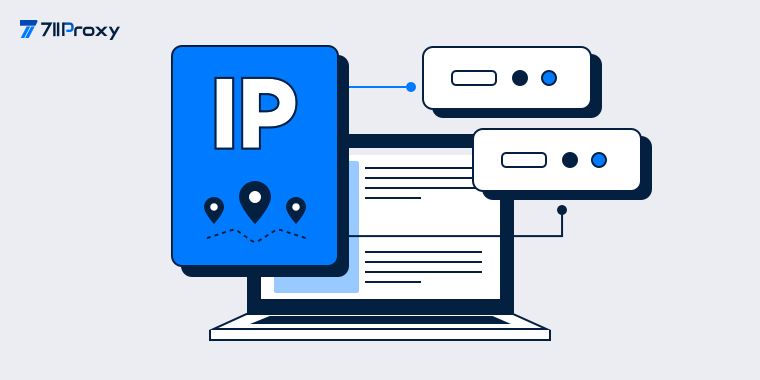
<p style="line-height: 2em;"><span style="font-size: 16px;">Teams running data collection often run into the same problem. The script works, a few thousand records come back first, then the site starts returning empty pages and error responses, and the job stops halfway. In most cases the code is fine; the issue lies in the network source behind each request. The following breaks down the causes in the order collection runs, then gives the corresponding residential proxy configuration.</span></p><p style="line-height: 2em;"><span style="font-size: 16px;"><br/></span></p><p style="line-height: 2em;"><span style="font-size: 24px;"><strong>Why Does Collection Stall?</strong></span></p><p style="line-height: 2em;"><span style="font-size: 16px;"><br/></span></p><p style="line-height: 2em;"><span style="font-size: 16px;">There are three common failure patterns. The first few hundred requests succeed, then failures surge after volume builds, which usually comes down to IP usage and request frequency. When the very first request gets rejected, the IP likely got identified as non-residential. When a page loads but shows fewer price, stock, or review fields than normal browsing, check whether you pulled a downgraded version.</span></p><p style="line-height: 2em;"><span style="font-size: 16px;">Datacenter IPs are the easiest to get flagged at this step. A datacenter IP is registered to a cloud provider like AWS or Google Cloud, and when one IP fires hundreds of requests in minutes, the site treats it as automated traffic.</span></p><p style="line-height: 2em;"><span style="font-size: 16px;">There is also a regional dimension. Scraping Amazon US prices or TikTok Shop local category pages directly from a domestic network returns the default or cross-border recommended version, not the page local consumers actually see. So the first move in any collection job is to send requests from the target market.</span></p><p style="line-height: 2em;"><span style="font-size: 16px;"><br/></span></p><p style="line-height: 2em;"><span style="font-size: 24px;"><strong>Residential IPs and Datacenter IPs</strong></span></p><p style="line-height: 2em;"><span style="font-size: 16px;"><br/></span></p><p style="line-height: 2em;"><span style="font-size: 16px;">Residential proxies and datacenter IPs belong to two different classes in terms of ownership and ASN. Residential ranges are registered to local broadband operators like Comcast, AT&T, and Deutsche Telekom, while datacenter ranges belong to cloud providers such as AWS and Google Cloud.</span></p><p style="line-height: 2em;"><span style="font-size: 16px;">Spread the request volume and the gap becomes clear. One collection round across 3 markets, 20 category pages each, run daily for 30 days, can push a single datacenter IP well past its tolerance line; spread across dozens of residential IPs, each IP's traffic falls back into a normal range.</span></p><p style="line-height: 2em;"><span style="font-size: 16px;"><br/></span></p><p style="line-height: 2em;"><span style="font-size: 24px;"><strong>How to Choose Residential Proxies for Different Collection Tasks</strong></span></p><p style="line-height: 2em;"><span style="font-size: 16px;"><br/></span></p><p style="line-height: 2em;"><span style="font-size: 16px;">1. Batch collection of public pages: use the rotating mode of <a href="https://www.711proxy.com/residential-proxies-gb" target="_blank" style="color: rgb(0, 176, 240); text-decoration: underline;"><span style="font-size: 16px; color: rgb(0, 176, 240);"><strong>dynamic residential proxies</strong></span></a>. Product pages, category pages, and public reviews are independent of each other, so a fresh IP per request keeps pressure on any single IP minimal. Rotation handles the source, but you still control the pace. One request every 5 to 10 seconds per IP, with backoff and retry on error. Start with 5 concurrent paths, add more as the failure rate allows, and drop concurrency if it exceeds 10%.</span></p><p style="line-height: 2em;"><span style="font-size: 16px;">2. Collection that needs a login session: use the sticky sessions of dynamic residential proxies. Login, pagination, and detail fetching form one continuous flow; switching IPs midway breaks the session. Keep one residential IP for 5 to 180 minutes and run the whole flow before switching.</span></p><p style="line-height: 2em;"><span style="font-size: 16px;">3. Small tasks that watch fixed pages long term: use static residential proxies. Watching a dozen fixed product pages, fetched once a week, keeps the exit unchanged so you can tell market movement from IP movement in price and stock.</span></p><p style="line-height: 2em;"><span style="font-size: 16px;"><br/></span></p><p style="line-height: 2em;"><span style="font-size: 24px;"><strong>Pay Per Traffic or Per IP?</strong></span></p><p style="line-height: 2em;"><span style="font-size: 16px;"><br/></span></p><p style="line-height: 2em;"><span style="font-size: 16px;">Match the billing model to the task shape. Collection that runs in occasional rounds fits pay-per-GB: you pay for what you use, and adjusting scope wastes nothing. Tasks that need to spin up large numbers of IPs at once fit per-IP billing better; the same batch can be reused, lowering the cost per IP.</span></p><p style="line-height: 2em;"><span style="font-size: 16px;">Traffic is the easiest line to misestimate. E-commerce and social pages carry heavy images and scripts, and one page can cost several times a plain-text endpoint. A safe approach is to pilot 5 real target pages for a day, record actual usage, then multiply by days and markets.</span></p><p style="line-height: 2em;"><span style="font-size: 16px;"><br/></span></p><p style="line-height: 2em;"><span style="font-size: 24px;"><strong>How 711Proxy Supports Collection Tasks</strong></span></p><p style="line-height: 2em;"><span style="font-size: 16px;"><br/></span></p><p style="line-height: 2em;"><span style="font-size: 16px;">1. Region alignment: check the target market, and the exit IP lands in the corresponding market. 711Proxy has over 100 million residential IPs, covering more than 200 countries and regions, with country- and state-level targeting, and can generate a proxy list by state. For Amazon US and German sites, simply use the residential IPs of the two respective markets.</span></p><p style="line-height: 2em;"><span style="font-size: 16px;">2. Session control: dynamic residential proxies support both rotating and sticky modes, with customizable sticky duration up to 180 minutes. Use rotation for batch page fetching and sticky for flows that need a login session, set them separately.</span></p><p style="line-height: 2em;"><span style="font-size: 16px;">3. Integration with existing workflows: protocols include HTTP and SOCKS5, authentication supports username/password and IP whitelist, and API extraction is provided, letting you plug directly into collection frameworks like Scrapy, Playwright, and Selenium, with ready-made approaches for both Python and Java.</span></p><p style="line-height: 2em;"><span style="font-size: 16px;">4. Billing aligned to task shape: collection that runs on a cycle with steady volume uses pay-per-GB, starting around $0.55/GB with traffic valid for 30 days. Tasks that need many IPs at once can use per-IP billing, with dynamic residential proxy IP plans starting at 50 for $10 total and no expiration. <a href="https://www.711proxy.com/static-residential-proxies" target="_blank" style="color: rgb(0, 176, 240); text-decoration: underline;"><span style="font-size: 16px; color: rgb(0, 176, 240);"><strong>Static residential proxies</strong></span></a> for long-term fixed-page watching are priced per IP, starting at $3.5/IP/month with unlimited traffic.</span></p><p style="line-height: 2em;"><span style="font-size: 16px;"><br/></span></p><p style="line-height: 2em;"><span style="font-size: 24px;"><strong>Summary</strong></span></p><p style="line-height: 2em;"><span style="font-size: 16px;"><br/></span></p><p style="line-height: 2em;"><span style="font-size: 16px;">Before the next collection round, list an exit plan by target market, spread request volume across enough residential IPs, then pilot once to measure real traffic. When you need separate configurations per market, 711Proxy's static and dynamic residential proxies can be combined.</span></p><p><br/></p>












'%3e%3cg%20id='ic/首页/向上'%20transform='translate(377,%20156)%20scale(1,%20-1)%20rotate(-90)%20translate(-377,%20-156)translate(370,%20149)'%3e%3crect%20id='矩形'%20x='0'%20y='0'%20width='14'%20height='14'%3e%3c/rect%3e%3cpolyline%20id='路径'%20stroke='%23042040'%20transform='translate(7,%207.5)%20scale(1,%20-1)%20translate(-7,%20-7.5)'%20points='12%205%207%2010%202%205'%3e%3c/polyline%3e%3c/g%3e%3c/g%3e%3c/g%3e%3c/svg%3e)