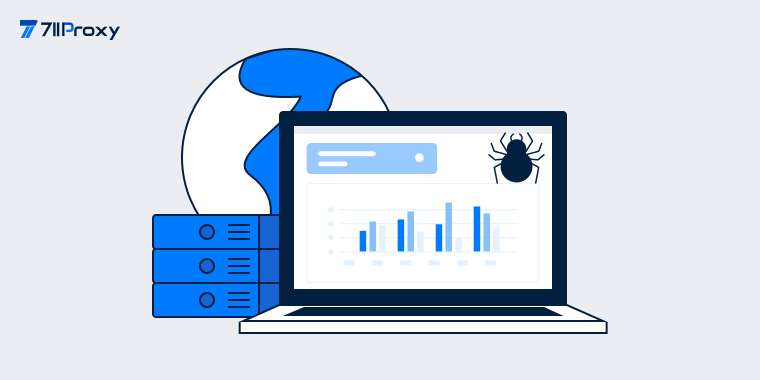
<p style="line-height: 2em;"><a href="https://www.711proxy.com/" target="_self" style="font-size: 16px; color: rgb(0, 176, 240); text-decoration: underline;"><span style="font-size: 16px; color: rgb(0, 176, 240);">IP proxies</span></a><span style="font-size: 16px;">are an indispensable stealth tool for Wikipedia data scraping, offering immense value for training large language models, building knowledge graphs, and conducting academic research. However, when actually starting to scrape, many developers encounter issues such as IP bans, table chaos, and parsing failures.</span></p><p style="line-height: 2em;"><span style="font-size: 16px;"><br/></span></p><p style="line-height: 2em;"><span style="font-size: 16px;">This article will share practical techniques to solve these core challenges.</span></p><p style="line-height: 2em;"><span style="font-size: 16px;"> </span></p><h1 style="line-height: 2em;"><strong><span style="font-size: 24px;">Why Scrape Wikipedia Data?</span></strong></h1><p style="line-height: 2em;"><span style="font-size: 16px;"> </span></p><p style="line-height: 2em;"><span style="font-size: 16px;">As the world's largest free online encyclopedia, Wikipedia covers accurate information across history, technology, culture, business, and various other fields, with authoritative content that is regularly updated.</span></p><p style="line-height: 2em;"><span style="font-size: 16px;"> </span></p><p style="line-height: 2em;"><span style="font-size: 16px;">Whether for scientific research data investigation, industry report writing, content material accumulation, or product information supplementation, scraping Wikipedia data saves significant time in information gathering and provides reliable data support for work and projects. This is the core reason why it has become the preferred data source for many practitioners.</span></p><p style="line-height: 2em;"><span style="font-size: 16px;"> </span></p><h1 style="line-height: 2em;"><strong><span style="font-size: 24px;">IP Restrictions: Core Techniques to Bypass Anti-Scraping</span></strong></h1><p style="line-height: 2em;"><span style="font-size: 16px;"> </span></p><p style="line-height: 2em;"><span style="font-size: 16px;">Wikipedia has strict anti-scraping mechanisms. Frequent requests from a single IP or excessively fast access speeds can easily be flagged as abnormal operations, resulting in IP bans and failed scraping.</span></p><p style="line-height: 2em;"><span style="font-size: 16px;"> </span></p><p style="line-height: 2em;"><span style="font-size: 16px;">The core technique involves controlling request frequency to simulate real user access patterns and avoid large-scale scraping within a short period. At the same time, pairing this with clean IP proxies allows for dynamic IP switching to bypass anti-scraping restrictions, fundamentally avoiding the risk of IP blacklisting.</span></p><p style="line-height: 2em;"><span style="font-size: 16px;"> </span></p><h1 style="line-height: 2em;"><strong><span style="font-size: 24px;">Data Chaos: How to Extract Accurately</span></strong></h1><p style="line-height: 2em;"><span style="font-size: 16px;"> </span></p><p style="line-height: 2em;"><span style="font-size: 16px;">Wikipedia pages have complex structures mixed with large amounts of redundant information, often leading to issues such as chaotic data scraping, excessive invalid data, and missing data.</span></p><p style="line-height: 2em;"><span style="font-size: 16px;"> </span></p><p style="line-height: 2em;"><span style="font-size: 16px;">It is recommended to clearly define scraping requirements in advance and precisely locate core data fields. Use parsing tools to filter key content and eliminate redundant information. At the same time, ensure stable IP connections to avoid data disorganization caused by connection interruptions, thereby improving scraping efficiency and data purity.</span></p><p style="line-height: 2em;"><span style="font-size: 16px;"> </span></p><h1 style="line-height: 2em;"><strong><span style="font-size: 24px;">Why Choose 711Proxy?</span></strong></h1><p style="line-height: 2em;"><span style="font-size: 16px;"> </span></p><p style="line-height: 2em;"><span style="font-size: 16px;">The success or failure of Wikipedia scraping largely depends on the quality of proxy IPs! 711Proxy has 100 million+ clean and verified IP resources, effectively bypassing Wikipedia's IP blocking mechanisms and is specifically designed for large-scale data scraping.�</span></p><p style="line-height: 2em;"><span style="font-size: 16px;">Additionally, 711Proxy supports rotation/sticky sessions, offering particular advantages for anti-scraping sensitive targets like Wikipedia. With a 99.7% high connection success rate, it maintains stable connections throughout, effectively avoiding scraping interruptions, data loss, and duplicate scraping caused by IP connection failures—significantly improving the completeness and efficiency of Wikipedia data scraping!</span></p><p style="line-height: 2em;"><span style="font-size: 16px;"> </span></p><h1 style="line-height: 2em;"><strong><span style="font-size: 24px;">Conclusion</span></strong></h1><p style="line-height: 2em;"><span style="font-size: 16px;"> </span></p><p style="line-height: 2em;"><span style="font-size: 16px;">The core of Wikipedia data crawling lies in breaking through IP restrictions and extracting data accurately. Choosing a clean and stable proxy IP is the key — with massive high-quality resources and high-performance IPs.</span></p><p style="line-height: 2em;"><span style="font-size: 16px;"> </span></p><p style="line-height: 2em;"><a href="https://www.711proxy.com/" target="_self" style="font-size: 16px; color: rgb(0, 176, 240); text-decoration: underline;"><span style="font-size: 16px; color: rgb(0, 176, 240);">711Proxy</span></a><span style="font-size: 16px; color: rgb(0, 176, 240);"></span><span style="font-size: 16px;"> helps you collect efficiently and operate stably, making your crawling tasks twice as effective with half the effort.</span></p><p><br/></p>












'%3e%3cg%20id='ic/首页/向上'%20transform='translate(377,%20156)%20scale(1,%20-1)%20rotate(-90)%20translate(-377,%20-156)translate(370,%20149)'%3e%3crect%20id='矩形'%20x='0'%20y='0'%20width='14'%20height='14'%3e%3c/rect%3e%3cpolyline%20id='路径'%20stroke='%23042040'%20transform='translate(7,%207.5)%20scale(1,%20-1)%20translate(-7,%20-7.5)'%20points='12%205%207%2010%202%205'%3e%3c/polyline%3e%3c/g%3e%3c/g%3e%3c/g%3e%3c/svg%3e)